Watering Your Child’s Imagination

“Imagination creates reality.” —Richard Wagner

Every musical masterpiece begins in the imagination of a composer. Every pitch sung begins in the mind of the singer. Every rhythm is counted conceptually before it is heard.

Imagination is key to originality and creativity, so it is imperative that we water the imaginations of the children in our lives. Children have all the raw materials to build fantastic imaginations, but many times they start to wane in their ability to continue the construction of a creative imagination as they grow into adolescence. Our modern sensibility of reality has become an opponent of imagination instead of a product of it, but I would argue as Wagner stated that imagination can give birth to a better, future reality. Our cultivation of imagination in our children has a direct relationship to the creative efforts they will accomplish in their adulthood.

So how do we water this little sapling in our children? Their imaginations are nothing we have created—they were born with their very own unique creative seedlings. However, there are definite ways we can nurture this sprout into a fully bloomed plant, complete with fruit production.

One way to water is to introduce an idea but leave it unfinished for our children to then complete. Musically, this can look a lot of different ways. Challenging students to fill in a rhyming word in some lyrics can be a quick, fun activity to get minds thinking. Playing an instrumental piece and asking students to write a story to express the song helps young students to notice and adapt musical expression into a more tangible form. Encouraging older students to create a harmony to accompany a familiar melody illumines the path for future composing.

Another way to water this imaginative interaction with music is to spend significant time on ear training. All singing begins with hearing, and all good singing begins with converting listening into quality sound production. Good listening in music involves not only the hearing of the original sound but then the hearing and adapting of the sound being sung back. You might be surprised at how profound this approach can affect the sound of your choir. Children know they should listen to learn a part, but they fail to continue listening as closely to their own voices when they are singing themselves. Holding rehearsal in a very live acoustic room or hall can be really fun for students as well as help them listen more carefully to themselves. Singing rounds also helps children to listen carefully to their own voices as they fit their part within a bigger setting. Round singing produces quite a bit of giggles at the start as kids realize what a mess it can become before they really pick it up, so have fun and allow time for a few times though the exercise. 🙂

One last idea to help children develop their imagination and creativity in music is to make it a multi-sensory experience. Although we perceive music primarily through our ears, I propose that all five senses can either directly experience music or connect to music through associative experiences. When our senses interact with music, we connect more deeply with it and become more able to mold and shape it in an organic and creative way.

For example, I can listen to a song and pull my visual muscles into the experience by assigning a color to the song. If you’ve seen Fantasia, you have seen one artist’s visual impression of a song. We should be encouraging our kids to explore music in this way. Once you do this with kids a few times, they will start offering colors or pictures before you even ask. How fun is that?!

Our family has also seen an associative experience of music through smell and taste. Certain music we have heard at restaurants automatically makes our taste buds crave that cuisine. We are almost able to conjure the smell just from hearing that style of music. So why not help your kids start making this fun association in a very intentional way? Why not bake brownies and have a listening party? The smell of warm chocolate and the decadent taste might just stick to the song, creating a warmth and familiarity the children will want to revisit. At the very least, your children will remember the event and get excited for the next listening party!

Sensing touch through music can be both physical and emotional in nature. Vibrations from live instruments can be felt throughout the body. Beethoven certainly yielded some of his most creative works after he lost his sense of hearing by using vibrations to guide him. It makes me wonder if he had already experienced music in such a multi-sensory way that he had full confidence in this method of composition. Emotionally, music can also be felt profoundly in the heart. I personally respond to moving pieces or even certain musical intervals with a prompt display of goosebumps. Sometimes tears will flood my eyes as well. Responding to music by the sense of touch can actually reveal a deeper interaction with the piece than merely sensing it through sound. Can you imagine what kind of creativity could come from children who are being encouraged to dig into music in this way? Marvelous!

This is just the tip of the iceberg when it comes to inspiring creativity and imaginative growth in our children, but I hope it has inspired your creativity in leading them down this road. The sweet privilege we have to shape little minds is such an honor to hold. We must keep our children singing and growing. Water these precious ones for a future generation of creatives who can lead the charge for years to come.


Why Kids Sing the Same Song Again and Again

We’ve all reached that limit—the one where we just can’t sing “Row, Row, Row Your Boat” one more time, but our preschoolers still persist until we give in. Each time we oblige, we have made the right decision! Even if we, as parents or teachers, feel the weight of the monotony of a repeated song, the benefits of that repetition are as good as gold for young singers. The thousandth time through a song yields vastly different rewards than the first time, and while variety might be the spice of an adult’s life, repetition is the meat and potatoes of a child’s life.

It is no secret that children learn through repetition, but the actual connections from several run-throughs of a favorite song run deeper than we think. Language development is huge during childhood. Even preteens are still figuring out conversational flow and vocabulary. Young children gain mastery of poetic language, word associations, and syllabic rhythms on top of vocabulary development and sentence structure from a song. This is no simple or obvious feat.

Imagine hearing a song in Portuguese for the first time. You might have the slightest awareness of Latin-based words to glean a loose sketch of the song, but only through focused repetition of the same song would you place the correct pronunciations with the correct rhythm in the correct order to the corresponding note. And you would still be struggling through the exact meaning. In fact, you might assign two syllables together that might otherwise be part of two different words, depending on how they fall in the structure of the melody. Toddlers and preschoolers are building their own awareness of language, and repetition of a song will help them gain the proper context for correct word usage and flow.

If you have ever heard a young child sing the “ABC Song,” you might notice a new word you have never heard before–ELEMINOPY. This word is rooted in the ancient Phoenician for “middle of the alphabet.” Just kidding! Actually, it is the letters in the middle of the alphabet L, M, N, O, and P. Does a 2-year-old understand these phonetic symbols and their order? Not yet, but one day these rote-memorized lyrics will become attached to their proper meaning. This metamorphosis takes much repetition!

Another strength of repetitive singing lies within the conceptual realm. Words are tricky! Many words have multiple meanings or sound like other words, and it takes practice to decode the meaning of a specific word in any given context. As children sing and sing and sing, they start to understand more and more what a song is about and can then use the words within the lyrics properly and fluently. Language learning can be challenging, but when it is paired with a mnemonic approach like music, deeper understanding and memory can be achieved.

Yes, not every song your child sings will be on your personal top 40 chart, but let the singing go on! Repetition and encouragement are all kids need to make their own beginner connections, and we want to build life-long singers and learners. If you feel like your own voice needs a break, find a great Spotify playlist for your toddler, but don’t let Spotify do all the work for you. Every time you sing WITH your child, you are building your relationship, and you’ll reap the benefits for years to come. Go ahead–put that song on for the fifty-first time! You won’t regret it.

7 Reasons to Sing with Your Toddler

Maybe you have been lamenting the fact that your Spotify profile boasts more Wee Sing and silly song hits than that indie acoustic band you discovered last year. Or perhaps you have to nurse your raw throat with honeyed tea after the marathon nursery song singalong you hosted in your child’s bedroom last night. Maybe you are relishing the fact that your little one doesn’t care if you can’t carry a tune in a bucket. Whatever situation you find yourself in, toddlers love music, and you are their primary DJ for the next decade, so let’s talk about all the wonderful benefits of singing with your toddler.

1.) Increased vocabulary

Just as reading picture books helps toddlers grow in language awareness by association, singing songs helps a toddler place words within a context. When a child practices these songs repeatedly, he is ordering new words and grasping their meaning in a cohesive way. The poetic element of music also assists a child understand the flow and rhythm of language.

2.) Motor skill development

Music, in general, provides the rhythm that a toddler unabashedly enjoys. He might jump or sway to the beat or simply tap his fingers gently. Although his dancing is quite clumsy, his little brain is hard at work to coordinate entire muscle groups to a perceived rhythm and mood. I am always intrigued by how easily a very young child can adapt his or her movements to the tempo and mood of a song.

Singing also adds another layer of coordination as the child matches verbal ideas with specific movements. “The Wheels on the Bus” is a perfect example of the concrete hand motions a child moves rhythmically to illustrate an idea that is being sung. We take this for granted as adults, but it is remarkable to see a toddler putting all of this together.

3.) Listening skills

Singing with your toddlers also introduces auditory discernment. Children must listen to understand and reproduce the words they hear. They also learn to match the volume and even the style of singing in some cases.

4.) Observation skills

Toddlers are not too young to begin hearing distinctions in different pieces of music. Questions like, “What instrument do you hear?” or “Should we march or tiptoe for this song?” help prompt them to take a moment to observe and even participate with newfound concepts.

5.) Aural development

Matching pitch might be one of the earliest refinements a child learns on his road to singing with others. In the preschool stage, children are beginning to understand that they may sing with others, so to prepare toddlers to make this transition, singing rounds like “Row, Row, Row Your Boat” may help tune their ears to match an outside pitch. Any song that has melodic intervals that are based on the tonic triad is excellent for little ears to begin making these pitch connections.

6.) Long-Term Memory

Music is magical! We have all heard the stories of the aged who cannot remember what happened earlier that day, but they can remember the songs from their childhood. We all employ music to aid our memory. Have you ever sung your ABC’s to alphabetize something? Do you skip count by 5’s in the sing-song way your third-grade teacher taught you? Yes, singing with toddlers teaches their brains to make pathways and store information in their long-term memory even before they comprehend the words they are singing. Remarkable!

7.) Building a loving bond

Lest we think that singing with our toddlers serves only utilitarian brain-building functions, I must mention that when you sing with your child, you are forming a lasting bond with her. That bond is filled with fun, love, and warmth. Studies indicate that people who sing together experience a rush of oxytocin, which is known as the bonding chemical. Those who sing together feel a connection that is not achieved in many other ways. It is such a beautiful byproduct of a delightful activity, and it costs nothing and takes no advance planning.

So what are we waiting for? Our house is filled with music for most of the day. We sing along with our streaming service, we make up silly songs, and we sing hymns in the evening. We dance and groove to our nursery songs, and we clap to songs with a strong pulse. My little guy loves music, and at 20 months, he is already singing and filling in the words he knows. Almost nothing excites him more than one of his favorite songs!

What are your kids’ favorite songs? Do you all sing together as a family? What children’s albums do your children enjoy? Please share! Remember: your children won’t recall if the laundry was always folded and put away, but they will remember that you sang with them everyday.

Conversing with Your Children about Current Events through Song

This year caught us all by surprise. We had no idea that society would shut down for several months, that graduation ceremonies would be canceled, or that toilet paper would become a luxury item. Yes, the new Roaring Twenties have, in fact, been roaring at us.

Our children might understand bits and pieces of the pockets of mayhem around them, but they might not be processing the picture as a whole. They might not even know the questions to ask, and we, as parents, might not even perceive they need to be answered. The longer I am a parent, the more I find these two statements to be true: 1.) Children are more aware and perceptive than they usually share, and 2.) children yearn for straightforward honesty from their parents first before any other source.

Because we live with this little audience looking for guidance, we must not neglect the opportunity to be there for these precious ones. Filling our homes with truth-saturated songs and occasionally pulling out a lyric of reassurance or asking a subtle question will help us engage with our children on a deeper level even during uncertain times. Quality hymns and songs speak to every part of human existence, so these heavier issues are bound to arise, and when they do, the resulting conversation is so much more organic.

For instance, Lauren Daigle’s “Trust in You” and MercyMe’s “Even If” both speak to navigating the world through faith in the Lord even when answers and full pathways are not clearly evident. A conversation of faith in God’s good character may ensue, and the songs will cause the truth to be stickier in little hearts and minds than a passing conversation. What an opportunity be the influence in your child’s life! Do not think that your preteen or teenager has forsaken your advice and confidence entirely! This unique time in history gives you the platform to build even more credibility with your growing children by the way you engage with them and support them when the world feels so chaotic. If you are not afraid to speak openly with your children, they will learn to come to you when they need to work out their own worldviews.

Think about what you need to hear right now. We all need a strong, calming voice to say, “Things are okay. The world is not out of control. There will be an end to the mess, and life will continue. You have hope because this is not all there is.” Now take a moment to consider that your children need to hear the same words. How can you give this to them? How can you approach this subject in a gentle way that will yield a deeper relationship? The songs that have touched your heart in recent days are waiting to be shared with your children. In a moment of vulnerability, you might give your children a glimpse into your interaction with current events and open that door to a genuine conversation.

Our children are the future leaders of our world. We have the privilege of parenting them and thereby molding the future of society. We must sing with them and talk with them and guide them. Your place in their lives is so important.

What songs have supported you during 2020? Have you learned any new songs this year? What old songs from your past have comforted you? Please share! One can never have too many songs in the arsenal!

A Hymn that Reads Like an Epic Adventure (and Why Our Kids Should Know It!)

We all love a good story. The twisting of a plot into a seemingly unsolvable knot causes our hearts to ache until the author masterfully pulls one thread that unravels the mess and brings relief through an appropriate ending. For centuries, poets and writers have presented epic adventures. These adventures present narratives which highlight the longing of humanity. Henry Wadsworth Longfellow (1807-1882) verbalizes this longing best in his poetic words, “The Wrong shall fail, the Right prevail, with peace on earth, good-will to men” (“Christmas Bells”). J. R. R. Tolkien (1892-1973), author of The Hobbit and The Lord of the Rings Trilogy, understood the power of the epic tale. His stories, rife with imagery, celebrate the theme of good triumphing over evil. Though times of darkness cloud the certainty of the desired outcome, those who sit with the books until the end experience restoration, justice, and completion.

The idea of the epic story, the quest for something higher, resides within all of us because we are players in The Story. From Creation to the Fall to the Cross and into Eternity, we are experiencing the struggle and the loss but also the redemption and future hope. Yes, we are living the epic tale ourselves.

Photo by Wendy van Zyl on Pexels.com

Martin Luther (1483-1546) penned “A Mighty Fortress” in 1529. He was no stranger to the struggles of the darkness of the world, and his language in “A Mighty Fortress” is reminiscent of the epics of old. Take a look at the following hymn:

A mighty fortress is our God,
A bulwark never failing:
Our helper He, amid the flood
Of mortal ills prevailing.
For still our ancient foe
Doth seek to work his woe;
His craft and power are great,
And armed with cruel hate,
On earth is not his equal.

Did we in our own strength confide,
Our striving would be losing;
Were not the right Man on our side,
The Man of God’s own choosing.
Dost ask who that may be?
Christ Jesus, it is he;
Lord Sabaoth is his name,
From age to age the same,
And He must win the battle.

And though this world, with devils filled,
Should threaten to undo us,
We will not fear, for God hath willed
His truth to triumph through us.
The Prince of Darkness grim,—
We tremble not for him;
His rage we can endure,
For lo! His doom is sure,—
One little word shall fell him.

That word above all earthly powers—
No thanks to them—abideth;
The Spirit and the gifts are ours
Through him who with us sideth.
Let goods and kindred go,
This mortal life also:
The body they may kill:
God’s truth abideth still,
His kingdom is for ever.

The stage is set with unfailing God forever enthroned as the victor, but the verses follow the surging darkness as the Adversary attempts to overthrow God and His creation. The Champion arises to fight the battle humanity is losing, and He completely crushes the enemy to redeem his people. The God of all eternity reigns from beginning to end, and His people renounce the world to live with Him in His Kingdom. If ever there was an epic story, the Biblical narrative certainly holds the preeminent place.

Children can understand a story of right and wrong, good and bad, and they are capable of absorbing the universal truths presented in the story. Singing songs like “A Mighty Fortress” not only fills their minds with Biblical doctrine, it touches their hearts in a relatable way. They see the full scope of the gospel story and learn that God fights the battle for us. They are comforted by God’s eternal attributes and matchless strength. They hope in their Savior to bring about the restoration we all crave. I believe we must teach our children this hymn and others like it because it will continue to unfold over the years of their life as they sing it. Fresh thoughts and deeper understanding will flood them through the different stages of their lives. We don’t have to worry about teaching every fine point of doctrine within the poetry because their own continued interaction with the text will bloom anew as they grow in their faith.

When we sing with our children, we are creating the next generation of singers. When we choose songs of substance, value, truth, and artistry, we are presenting those singers with the gift of a lifetime of doctrinal beliefs stored in a transportable, lasting package. Let’s sing with our children!

Identity Songs to Sing with Your Children

Photo by Bich Tran on Pexels.com

The songs we choose to sing with our children have such a lasting impact because of the stickiness of music itself. A good melody becomes the four-lane highway delivery system to build a strong and centered source of truth that will whisper constantly in our children’s ears. Even when our children move away from home, they will take the songs of their childhood in their hearts with them, so we must take action now to lay that ever sure foundation of true identity.

Our identity is our unique perception of who we really are, our philosophical self-portrait. This construct informs all of our decisions and tethers us to our prescribed worldview. As our children grow and become more acquainted with the world and how it works, they will build their identity as they discover how they fit into world. Guiding a child through this process is a long game skill, but I do believe that there are some truths children (and adults) can never hear too often. For Christians, some of these truths are that we are God’s children, that we have been chosen, that we have a worth ascribed to us by God, and that we are secure in our standing before God.

I have begun to curate a playlist of identity songs to teach my children and to have playing in our home, and I would love to share them with you.

My first selection is “My Worth Is Not in What I Own” by Keith and Kristyn Getty and Graham Kendrick. My favorite lyrics belong to the second verse and speak so acutely to children and their whole world of dreams stretching before them:

My worth is not in skill or name
In win or lose, in pride or shame
But in the blood of Christ that flowed
At the cross.

We have this song playing all the time, and my girls know all the words by heart. I especially like the version with the duet by Fernando Ortega and Kristyn Getty. Check it out!

The second song in my list is “Greater” by MercyMe. This is a really fun song for kids because it is upbeat and catchy, but there is a wealth of scriptural truth woven into the lyrics. Anytime I find a song with direct scripture quotes, I pay attention to it. I cannot think of a better identity for my children to have than being a redeemed child of the all-powerful God.

‘Cause I hear a voice and He calls me redeemed
When others say I’ll never be enough.
And greater is the One living inside of me
Than he who is living in the world.

I heard my third song selection, “From the Day,” for the first time at a conference several years ago when I Am They was the worship band. Let me just quickly add that if you have not heard of this band and do not know the meaning behind their name, it is worth your time to look up because it sheds light on a great truth! This song reminds us of our journey from darkness to light and calls us to live in the joy of the redeemed.

When You found me, I was so blind
My sin was before me, I was swallowed by pride
But out of the darkness, You brought me to Your light
You showed me new mercy and opened up my eyes

From the day You saved my soul
‘Til the very moment when I come home
I’ll sing, I’ll dance, my heart will overflow
From the day You saved my soul

The call to a new life in Christ changes every part of us, and we are commanded to only look forward as a runner does in a race. The prolific hymn writer, Fanny Crosby, penned a joyful hymn of deep understanding of her new life in Christ. “Blessed Assurance” packs several deep scriptural truths about the identity of a believer being rooted in the work of Christ.

Blessed assurance, Jesus is mine
O what a foretaste of glory divine
Heir of salvation, purchase of God
Born of His Spirit, washed in His blood

As we teach our children the importance of their identity being rooted in Christ, we must also remind them that they have all they need in Jesus right now—“Jesus is mine.” They are presently an heir and forever belong to the Lord. We must never take for granted our children’s understanding of how they view themselves in the present. So much of our discipleship is of a forward-looking nature (future in heaven, one day seeing Jesus, etc.), but our children can greatly benefit from the reminder of who they are in Christ right now, and “Blessed Assurance” certainly fits the bill in this case. As one bonus song thrown in, I really enjoy “My Story” by Big Daddy Weave, which has an allusion in the bridge to Fanny Crosby’s hymn. It might be a good add-on after your kids have become familiar with “Blessed Assurance.”

Next is “Be Thou My Vision.” Oh, that our children would see life, the world, themselves through a lens crafted by their Heavenly Father! This ancient hymn is a profound prayer for the believers to keep their minds and hearts set upon their Savior amidst the distractions of this world. Every stanza brims with scriptural truth. In our modern culture of excess and self-promotion, I pray that my children can remember and live by these words:

Riches I heed not, nor man’s empty praise
Thou mine Inheritance, now and always
Thou and Thou only, first in my heart
High King of Heaven, my Treasure Thou art

My playlist for my children is ever growing, and I could mention dozens more songs, but this is a short read, not a novella. Let me simply close with the song, “Before the Throne of God Above,” written by Charitie Lees Bancroft (tune by Vikki Cook), which speaks to our standing as the Redeemed. The second verse reminds us to cling to the reality of Romans 8:1, “There is therefore now no condemnation for those who are in Christ Jesus.”

When Satan tempts me to despair,
And tells me of the guilt within,
Upward I look, and see Him there
Who made an end to all my sin.
Because the sinless Savior died,
My sinful soul is counted free;
For God the just is satisfied
To look on Him and pardon me

I pray for a shame and guilt-free life for my children because they have fully realized their Savior’s sacrifice and forgiveness. Whispering this truth into their ears, “Before the Throne of God Above” shatters the former claims of this world and spiritual darkness on the believer’s soul.

Like I mentioned before, I am discovering and rediscovering songs that speak to our standing with God, but I hope this very short list gets your mind marinating on the lyrics of songs you want to share with your children on who they are. Identity has become such a crucial part of modern thinking, and with the individual’s primacy rising to a peak in modern American culture, we need to be having these conversations with our children. If we don’t, the world will fill in the blanks, and it is a bankrupt alternative to the high calling placed upon Christians.

Subtle conversations through song and direct conversations when the moment strikes will be a great way to keep those lines of communication open. As your children grow and even leave the house, their connection with you might change but it won’t wane. I still love talking with my dad about songs, and we have lived states apart for a decade and a half. Our children are too precious and the years are too short to wait to speak heart to heart with them. Sing together, laugh together, and encourage one another with “psalms and hymns and spiritual songs” while they are under your wing.

Encouraging Our Kids to Compose

Photo by Pixabay on Pexels.com

Recently I attended a webinar about music composition, and one idea in particular struck me with its simplicity and profundity. We, as parents or educators, need to encourage our children to start experimenting with music composition. Many times a student’s very first encounter with the creative process of intentional writing begins at the tail end of childhood or adolescence, but most children who live in a music-rich environment begin playing around with melodies and silly made-up songs even from their preschool years. With this assumption in mind, I believe there are some very tangible and direct ways we can foster creativity in music composition.

The first thought I have when I think about the creative process is that we all need to be feeding ourselves with the wonders of the world around us in order to have a wide and diverse pool of material to synthesize into our own unique output of artistry. If we were only able to see the primary colors, our paintings would fail to include orange, purple, and green because our awareness and experience would limit us. So to foster musical creativity in our children, we must spend considerable time investing in their exposure to and practicing of a wide range of music. Picture a nice tall glass. Now imagine that glass is filled to the brim with your favorite frosty, sweet beverage–maybe strawberry lemonade. Now picture that glass being bumped even the slightest bit, and you should see the results of a soaked napkin and a less full glass of lemonade. If the original glass had been filled only one-half of the way from the start, the little nudge would not have upset the liquid enough to spill out. You see, our children need a rich reservoir to equip their efforts in order to make a splash big enough to light an inner passion. Creativity feeds off inspiration, and with only a shallow pool of ideas, the growth of a young artist might be stifled. Let’s serve our children with a musical feast!

A second idea I have been contemplating is that we need to be more proactive in our encouragement of our young children to experiment with writing their own songs. For example, preschoolers are in a stage of testing the “what ifs” of life. They play out several different scenarios to determine which would be feasible in the very real world they are discovering. Musically, we can help our little bitties to riff on a nursery song to explore the possibilities. We can sing a gentle variation of a well-known song or perhaps end on a high pitch instead of a low pitch to demonstrate the art of arranging. The more we interact with music along with our children in this way, the more our young kids will be able to diversify their own interaction with music. We need to let them know it is absolutely allowed to bend and shape melodies to their own liking as they develop their own tastes.

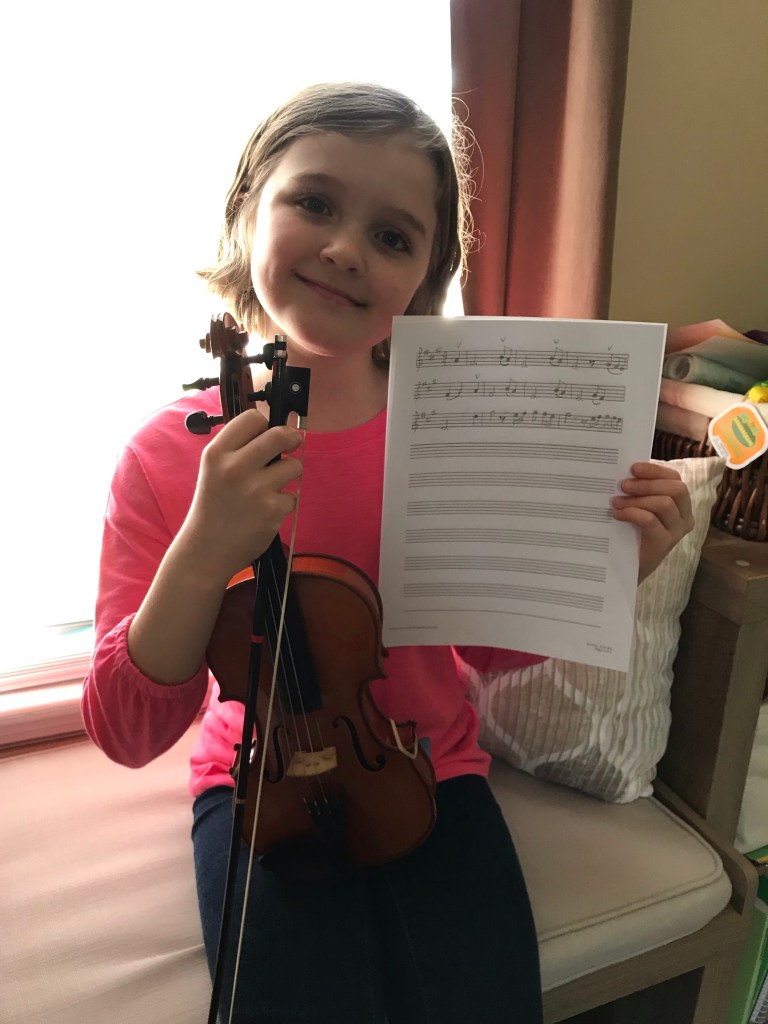
Older students may be ready to start with a clean staff and construct a working melody of their own. My 8-year-old daughter has just entered this stage, and I am loving this front seat view of her creative experimentation. When she presents a rather notable melody, I grab my phone to voice record her humming it. Then we put it down on manuscript paper. She plays the violin, so we always choose a key that is playable for a young violin student. When my daughter sees her own original melody written on paper, she can hardly contain her excitement and feels like it would be a complete waste of a day unless she plays it.

I believe that our children need to be given many opportunities to create and create and create. If they write 100 melodies in a year, they will be able to start discerning a good tune from a lesser one, a good hook from an unmemorable phrase. And as we feed this passion with music from great sources as well as the space and time to explore, a unique and deep artistry will sprout and grow and might even start spreading seeds of its own. Join with me in encouraging young writers!

Making the Most of a Remote Rehearsal

Zoom has taken over in all kinds of applications from meetings to classes to rehearsals, but for musical applications, the delay component and sound quality can hinder some of the aspects of singing as a group. So how do we hold profitable rehearsals that are worth the time and effort?

I think the key is looking at all of the building blocks which lead up to the act of singing together and then forming a working plan of cultivating those skills in a broken-down format. For example, singing a scale together in unison might be difficult because of a lag, so assign each student a numbered note in the scale to sing. Each student will be practicing attentiveness, listening, and pitch production. For more advanced students, you can even assign different variations on the scales such as interval jumps in an ascending or descending pattern, and the students will need to correctly construct the pattern using their assigned pitch. And a few laughs at the absurdity of the whole ordeal might even loosen everyone up!

Another trick to singing together over Zoom is to have all participants except the director mute themselves. This allows students to sing along with the director without experiencing the loop of a lag on the feedback. One drawback of using this method is that the director will not be able to hear the voices of his or her students, but this will still provide an avenue to keep songs fresh or even introduce a new song as students follow along with a piece of sheet music.

One final thought as we all figure out this approach to music education is to pull out all of those rusty music games from the archives. Games can keep students interested and still provide many ways to practice musical skills in less-than-ideal conditions. One game my students have always enjoyed is called Salami (sol la mi). I think this game would be perfect in a remote rehearsal setting! The instructor sings the pitches sol-la-mi and has the students sing back to orient themselves to the pitches. Using Curwen hand signs for the pitches is also a great way to engage the students in a multi sensory way. Then the instructor begins to sing and sign other three-note series such as do-re-mi or la-ti-la and has the students repeat. Every once in a while, the instructor should slip sol-la-mi into the patterns. Students then should remain silent and not sing sol-la-mi. If they sing it, they are “out.” The instructor can ramp up the speed in which he or she delivers the series, and the faster the pitches come, the harder it is to stay silent when “salami” rolls around. You can continue until only one student remains. It can become like virtual musical chairs! My students have always enjoyed this game, and I have even used step bells or a keyboard from time to time just to change things up.

I hope this post might bring a fresh perspective as you adapt to the “new normal” of distance directing. Please share your rehearsal ideas with me. I’m sure there is a wealth of inspiration to be had if we all pool our experiences and resources. During this unique time, we can learn so much from each other and come out on the other side of this better and more equipped directors!

Making the Most of a Remote Rehearsal

Zoom has taken over in all kinds of applications from meetings to classes to rehearsals, but for musical applications, the delay component and sound quality can hinder some of the aspects of singing as a group. So how do we hold profitable rehearsals that are worth the time and effort?

I think the key is looking at all of the building blocks which lead up to the act of singing together and then forming a working plan of cultivating those skills in a broken-down format. For example, singing a scale together in unison might be difficult because of a lag, so assign each student a numbered note in the scale to sing. Each student will be practicing attentiveness, listening, and pitch production. For more advanced students, you can even assign different variations on the scales such as interval jumps in an ascending or descending pattern, and the students will need to correctly construct the pattern using their assigned pitch. And a few laughs at the absurdity of the whole ordeal might even loosen everyone up!

Another trick to singing together over Zoom is to have all participants except the director mute themselves. This allows students to sing along with the director without experiencing the loop of a lag on the feedback. One drawback of using this method is that the director will not be able to hear the voices of his or her students, but this will still provide an avenue to keep songs fresh or even introduce a new song as students follow along with a piece of sheet music.

One final thought as we all figure out this approach to music education is to pull out all of those rusty music games from the archives. Games can keep students interested and still provide many ways to practice musical skills in less-than-ideal conditions. One game my students have always enjoyed is called Salami (sol la mi). I think this game would be perfect in a remote rehearsal setting! The instructor sings the pitches sol-la-mi and has the students sing back to orient themselves to the pitches. Using Curwen hand signs for the pitches is also a great way to engage the students in a multi sensory way. Then the instructor begins to sing and sign other three-note series such as do-re-mi or la-ti-la and has the students repeat. Every once in a while, the instructor should slip sol-la-mi into the patterns. Students then should remain silent and not sing sol-la-mi. If they sing it, they are “out.” The instructor can ramp up the speed in which he or she delivers the series, and the faster the pitches come, the harder it is to stay silent when “salami” rolls around. You can continue until only one student remains. It can become like virtual musical chairs! My students have always enjoyed this game, and I have even used step bells or a keyboard from time to time just to change things up.

I hope this post might bring a fresh perspective as you adapt to the “new normal” of distance directing. Please share your rehearsal ideas with me. I’m sure there is a wealth of inspiration to be had if we all pool our experiences and resources. During this unique time, we can learn so much from each other and come out on the other side of this better and more equipped directors!