

Most children enjoy music from an early age. In fact, a mother’s singsong voice creates a special bond with her child from infancy. Singing, then, becomes a natural response as a child seeks to participate in this wonder we call music. As a children’s choir director, I’ve had the privilege to serve in positions ranging from preschool through early high school, and I have always enjoyed watching children discover their musical talent during each stage of development.
The earliest singers (infants through 2 years) are in a constant state of discovery. Every taste, every book, every animal at the zoo are new to these precious little ones. Because of this newness, music may literally rock their world, and their most amazing musical discovery during this stage is that they can sing, TOO! I want you to imagine that you are your child’s tour guide through these new experiences. As you sing songs to your child, always keep the invitation open for him or her to join you.
One of my favorite activities to do with my very little ones is to lead them in a singsong mimicking game. I sing a simple monosyllabic la or ma in a repeated pattern of pitches and wait for them to try to sing it back to me. Then we repeat the game a few times before I sing a simple nursery song with them to let them make a connection. At six months of age, you will get a stare of wonder back, possibly with a sound or two, but don’t think that this game is not being absorbed. After a few months of consistent practice, the studied look will turn into a sweet little voice learning to sing. It just might be the cutest sound you will ever hear.
One important note about the mimicking game is that all children will develop differently, so keep it consistent, even if it seems that your child is losing interest or has a beautiful song one day only to sing nothing for two weeks after. Music is much like a language with inflection, phrasing, and sounds, so singing will be a building activity over time.
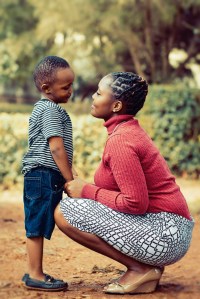 The next stage, the preschool age of 3-6, consists of a time of learning to join others and interact as part of a group. We see this happen as children begin to play with each other instead of playing next to one another. A preschool singer knows he can sing himself, but he discovers that he can also sing as part of a group. If you have been inviting your child to join you in singing, he will begin to see that he can sing with his peers, too. Over these years, I love to cultivate this idea of singing together as one voice. Some added benefits are that you can start to fine tune listening skills as you encourage your child to sing with others instead of next to each other. (Who wouldn’t want that?!) One activity to help foster this growth in your preschoolers are to start singing a familiar nursery song but stop before you finish the phrase. Your preschoolers will want to finish the phrase and then keep singing with you when you join them. Also, whenever you hear your preschoolers singing, if possible, start singing along with them. Along with the invitation to join in your song, this builds the awareness of singing together both from a leading and a following position.
The third and fourth stages overlap and seem to vary greatly depending on the wiring of each child. My primary background in music education has been spent working with elementary and middle school children, so this is where I tend to geek out! The third stage is one of singing to make music, not merely sound. When our children are very young, we simply want them to understand that their voices can make a musical sound and that it can make that sound with others. During the third stage, they have acquired the skill to listen to the music and voices around them, so they are ripe for an activity of voice molding. This molding is not operatic training but simply a fun, leveled up version of the mimicking game you played with your children when they were toddlers. I like to ask my children or students, “Can you sing this phrase like I do?” Then I sing the phrase in many different ways, including a few silly ways, and I invite them to mimic me. With this simple game, you are working on dynamics, vowel sculpting, tempo, and many other singing techniques, and it gives you an opportunity to help your young singers differentiate between full-voiced singing and non-musical shouting.
 Once children are able to change their singing style on command, they usually move into the fourth stage of vocal development. This stage takes them all the way into advanced choral singing in the later high school years. Your children really start to blossom as singers when they begin sing to serve the song. Serving a song involves singing in an appropriate style as part of the group with proper ornamentation. Some activities to start this stage are to sing rounds with your children and to introduce a wide variety of genres of singable music. Rounds like “Row, Row, Row Your Boat” or “Father, I Adore You” begin the task of harmonic singing because of the listening/focusing skill that must be present. With a round, a child starts to hear viable harmony structures, and you can then introduce a second part (usually a higher harmony works best for younger children) phrase by phrase.
Singing a wide range of genres from classical pieces to world pieces to gospel pieces will naturally develop your child’s ear to different styles of vocals and ornamentation. We can all learn when we push ourselves outside our normal listening world, so I would encourage you to become a student yourself and dive into a new genre this week! Your children, now in upper elementary and middle school, will benefit from focused listening as they are asked to notice nuances in different styles of music. As they get to practice different styles, they might just find what I like to call their own VFL (Voice for Life–more on that another time). And isn’t that exactly what we want–to instill a lifelong love of singing in our children?
What other activities do you enjoy with different age groups? We could probably talk for hours on this subject alone, so I would love to hear from you!
Singing with our kids. I can’t imagine a world where we couldn’t connect this way. Remember, your children will stack up piles of memories of singing together if you do it daily, so there is no time like the present!
 Come Sing Together